

How to take advantage of the 1 July super cap increase

March 14, 2024

From 1 July 2024, the amount you can contribute to super will increase. We show you how to take advantage of the change.

The amount you can contribute to superannuation will increase on 1 July 2024 from $27,500 to $30,000 for concessional super contributions and from $110,000 to $120,000 for non-concessional contributions.


The contribution caps are indexed to wages growth based on the prior year December quarter’s average weekly ordinary times earnings (AWOTE). Growth in wages was large enough to trigger the first increase in the contribution caps in 3 years.

Other areas impacted by indexation include:


  • The Government super co-contribution – Income threshold
  • The super guarantee maximum contribution base (the limit for compulsory super guarantee payments)
  • The tax-free thresholds for redundancy payments
  • The CGT contribution cap (amount that can be contributed to super following the sale of eligible business assets)


For those with the disposable income to contribute, superannuation can be very attractive with a 15% tax rate on concessional super contributions and potentially tax-free withdrawals when you retire. For business owners who might have had an exceptional year or sold their business, it's an opportunity to get more into super. However, the timing of contributions will be important to maximise outcomes.


If you know you will have a capital gains tax liability in a particular year, you may be able to use ‘catch up’ contributions to make a larger than usual contribution and use the tax deduction to help offset your capital gain tax bill. But, this strategy will only work if you meet the eligibility criteria to make catch up contributions and you lodge a Notice of intent to claim or vary a deduction for personal super contributions, with your super fund.

The bring forward rule enables you to bring forward up to 2 years’ worth of future non-concessional contributions into the year you make the contribution – this is assuming your total superannuation balance enables you to make the contribution and you are under age 75.


If you utilise the bring forward rule before 30 June, the maximum that can be contributed is $330,000. However, if you wait to trigger the bring forward until on or after 1 July, then the maximum that can be contributed under this rule is $360,000.

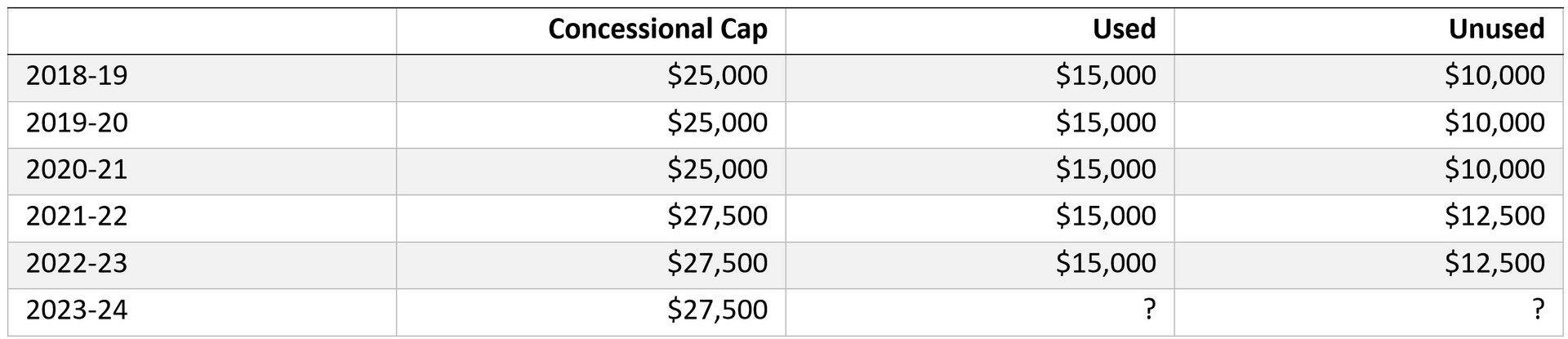
If your super balance is below $500,000 on the prior 30 June, and you want to quickly increase the amount you hold in super, you can utilise any unused concessional super contributions amounts from the last 5 years.


Let’s look at the example of Gary who has only been using $15,000 of his concessional super cap for the last few years. Gary’s super balance at 30 June 2023 was $300,000, so he is well within the limit to make catch up contributions.

Gary could access his $27,500 concessional cap for 2023-24 plus the unused $55,000 from the prior 5 financial years.


If Gary doesn’t access the unused amounts from 2018-19 by 30 June 2024, the $10,000 will no longer be available.

Transfer balance cap unchanged

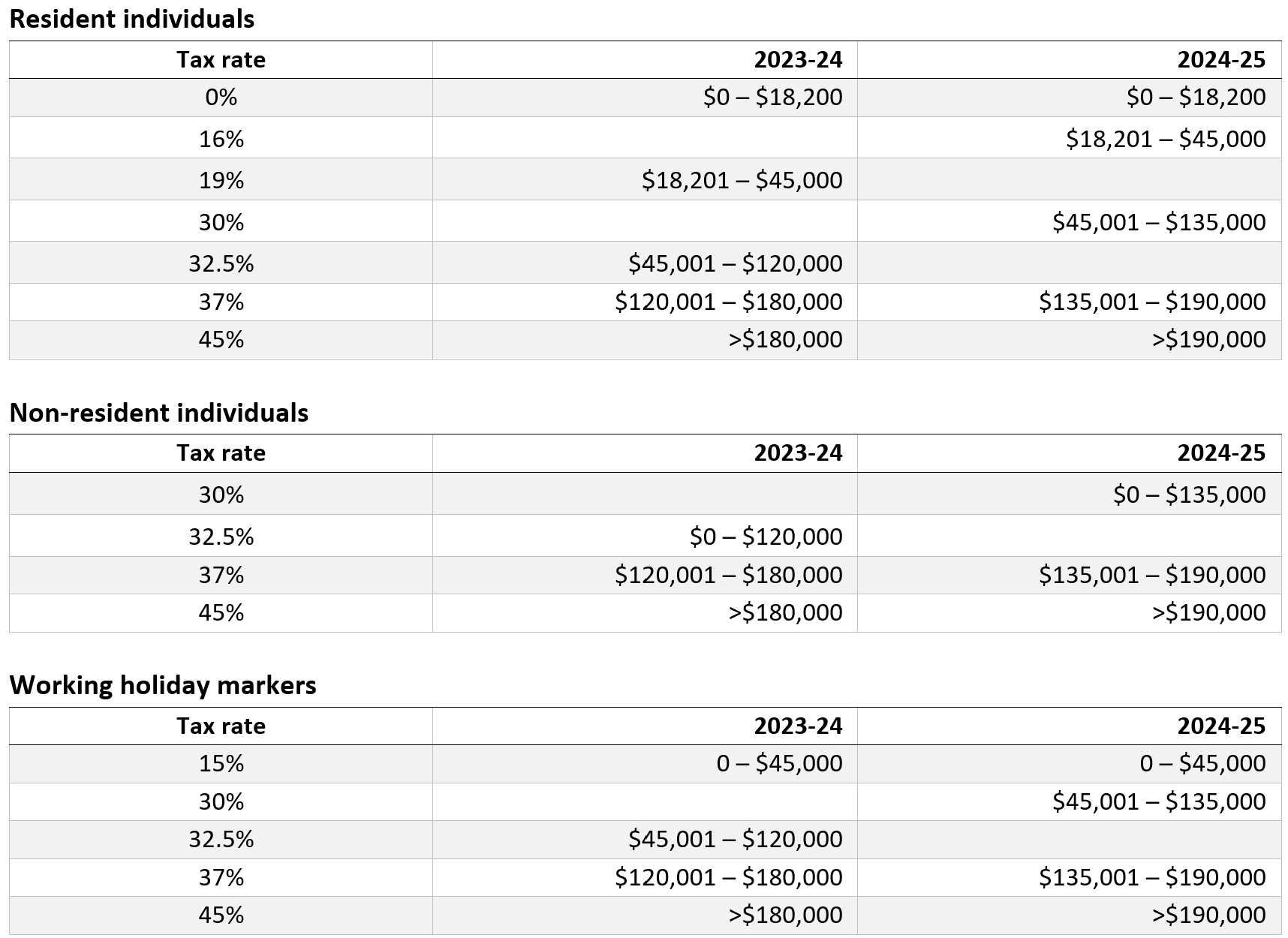
The revised stage 3 tax cuts have passed Parliament and will come into effect on 1 July 2024.

Before the new tax rates come into effect, check any salary sacrifice agreements to ensure that they will continue to produce the result you are after.

Revised stage 3 tax cuts confirmed for 1 July

The revised stage 3 tax cuts have passed Parliament and will come into effect on 1 July 2024.

Before the new tax rates come into effect, check any salary sacrifice agreements to ensure that they will continue to produce the result you are after.


By Wright Partners Client March 10, 2026
The Fringe Benefits Tax (FBT) year ends on 31 March. We’ve outlined the hot spots for employers and employees.

March 8, 2026
The ATO has issued a Draft Taxation Determination TD 2026/D1 which looks at how inherited family homes are treated for CGT purposes
By Wright Partners Client March 7, 2026
Self managed superannuation funds (SMSFs) can offer significant flexibility, allowing the members to make investments and enter arrangements that may not be available through retail or industry superannuation funds.
By Wright Partners Client March 5, 2026
Running a business from home—whether as a sole trader, freelancer, or small operator—has many perks.
By Wright Partners Client March 4, 2026
Running a successful business is hard work
February 16, 2026
When clients sell a long-held family home, they may be able to channel part of the proceeds into superannuation by using the downsizer contribution rules.
February 16, 2026
As a business owner or investor, time is always tight...
February 16, 2026
Electric vehicles (EVs) are no longer a niche choice...
February 10, 2026
For many Australians, a holiday home does double duty...
By Erin Robertson December 4, 2025
For years, businesses have been moving away from cash – and for good reason.
Show More