
Stage 3 personal income tax cuts redesigned

February 6, 2024

The personal income tax cuts legislated to commence on 1 July 2024 will be realigned and redistributed under a proposal released by the Federal Government.

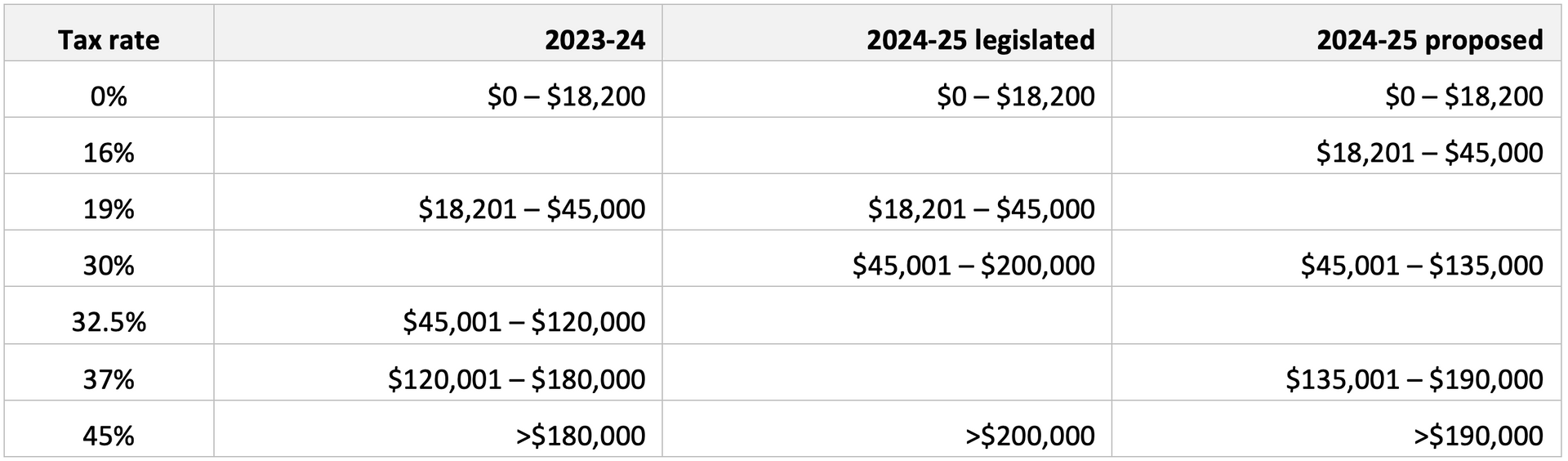
After much speculation, the Prime Minister has announced that the Government will amend the legislated Stage 3 tax cuts scheduled to commence on 1 July 2024. Relative to the current Stage 3 plan, the proposed redesign will broaden the benefits of the tax cut by focussing on individuals with taxable income below $150,000. If enacted, an additional 2.9 million Australian taxpayers are estimated to take home more in their pay packet from 1 July.


It's not how Stage 3 of the 5 year plan to restructure the personal income tax system was supposed to work, but a sharp escalation in the cost of living has reshaped community sentiment. As the Prime Minister said, “we are focussed on the here and now” and by default, not on long term structural change.


The redesign will increase Government revenues from personal income tax by an estimated $28 billion to 2034-35 as bracket creep takes its toll. 

What will change?

The revised tax cuts redistribute the reforms to benefit lower income households that have been disproportionately impacted by cost of living pressures.

Under the proposed redesign, all resident taxpayers with taxable income under $146,486, who would actually have an income tax liability, will receive a larger tax cut compared with the existing Stage 3 plan. For example:


  • An individual with taxable income of $40,000 will receive a tax cut of $654, in contrast to receiving no tax cut under the current Stage 3 plan (but they are likely to have benefited from the tax cuts at Stage 1 and Stage 2).
  • An individual with taxable income of $100,000 would receive a tax cut of $2,179, which is $804 more than under the current Stage 3 plan.


However, an individual earning $200,000 will have the benefit of the Stage 3 plan slashed to around half of what was expected from $9,075 to $4,529. There is still a benefit compared with current tax rates, just not as much.


There is additional relief for low-income earners with the Medicare Levy low-income threshold increasing by 7.1% in line with inflation. It is expected that an individual will not start paying the Medicare Levy until their income reaches $26,000 and will not pay the full 2% until $32,500 (for singles).


While the proposed redesign is intended to be broadly revenue neutral compared with the existing budgeted Stage 3 plan, it will cost around $1bn more over the next four years before bracket creep starts to diminish the gains.

It’s not a sure thing yet!

The Government will need to quickly enact amending legislation to make the redesigned Stage 3 tax cuts a reality by 1 July 2024. This will involve garnering the support of the independents or minor parties to secure its passage through Parliament – Parliament sits from 6 February 2024.

How did we get here?

First announced in the 2018-19 Federal Budget, the personal income tax plan was designed to address the very real issue of ‘bracket creep’ – tax rates not keeping pace with growth in wages and increasing the tax paid by individuals over time. The three point plan sought to restructure the personal income tax rates by simplifying the tax thresholds and rates, reducing the tax burden on many individuals and bringing Australia into line with some of our neighbours (i.e., New Zealand’s top marginal tax rate is 39% applying to incomes above $180,000).


The three point plan introduced incremental changes from 1 July 2018 and 1 July 2020, with stage 3 legislated to take effect from 1 July 2024.

What now?

If you have any concerns about the impact of the proposed changes, please call us to discuss.


For tax planning purposes, for those with taxable income of $150,000 or more, the redesigned Stage 3 tax cuts offer less planning opportunity than the current plan. But, any change in the tax rates is an opportunity to review and reset to ensure you are taking advantage of the opportunities available, and not paying more than you need.


February 16, 2026
When clients sell a long-held family home, they may be able to channel part of the proceeds into superannuation by using the downsizer contribution rules.
February 16, 2026
As a business owner or investor, time is always tight...
February 16, 2026
Electric vehicles (EVs) are no longer a niche choice...
February 10, 2026
For many Australians, a holiday home does double duty...
By Erin Robertson December 4, 2025
For years, businesses have been moving away from cash – and for good reason.
By Erin Robertson December 3, 2025
The ATO’s rules on self-education expenses are strict, and the line between “deductible” and “non-deductible” can be thin. Getting it right could mean thousands back in your pocket; getting it wrong could mean an ATO adjustment, plus interest and penalties.
By Erin Robertson December 2, 2025
Running, or deciding to set up a self-managed super fund (SMSF) gives you control, but it also brings legal responsibilities.
By Erin Robertson December 1, 2025
If you run a business, you already know the juggling act that comes with managing the payroll process — paying staff on time, managing cash flow, and staying compliant.
By Erin Robertson November 11, 2025
Many businesses hold critical data that poses significant risk to both businesses and their customers if the data they hold is not safeguarded from cybersecurity threats.
By Erin Robertson November 11, 2025
A new Bill before Parliament – the Treasury Laws Amendment (Strengthening Financial Systems and Other Measures) Bill 2025 – proposes several key changes that could affect small businesses, listed companies, and the not-for-profit sector.
Show More