The Billion Dollar TikTok Scandal

September 13, 2023

$1.7 billion paid out in fraudulent refunds, another $2.7bn in fraudulent claims stopped, around 56,000 alleged perpetrators and over 100 arrests to date. How did the TikTok tax scandal get out of control?

It was promoted as a victimless hack that delivered tens of thousands of dollars into your bank account. Like any hack, taking part was as simple as following the instructions. The streamlined process designed to make it easy for a small business to start-up under Australia’s self-assessment system, also made it easy for the ‘TikTok fraud’ to go viral.

How did it happen?

At some point in 2021, videos started to spread that spelt out how to get the Australian Taxation Office (ATO) to deliver money into your account. Not quite a loan but a hack that sometimes saw tens of thousands delivered into accounts, no questions asked. As the message gained traction, and with more and more people validating the hack, facilitators emerged. All you had to do was hand over your personal details to the facilitators and they would take care of the rest.


The fraud saw offenders inventing fake businesses, applying for an Australian Business Number (ABN), many in their own names, then submitting fictitious Business Activity Statements (BAS) to claim GST refunds.


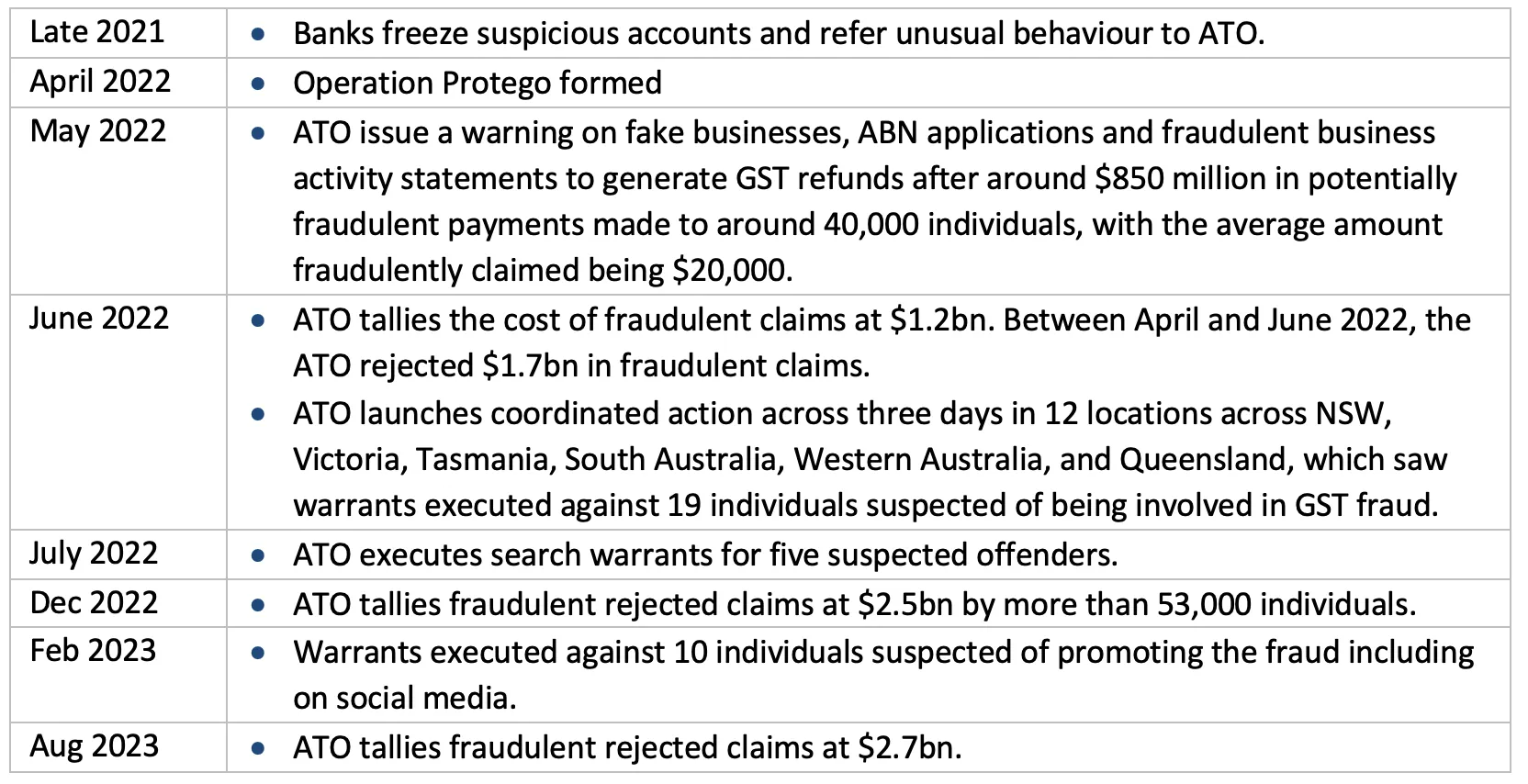
By late 2021, the Banks noticed the uptick in suspicious activity, mostly large refunds that were out of character for those accounts - in some cases, Centrelink recipients receiving large credits from the ATO. The banks froze a number of accounts and reported the suspicious matters as they are required to do under the Anti-Money Laundering & Counter Terrorism legislation, including to the ATO.


In April 2022, the ATO formed Operation Protego to disrupt the rapid increase in GST refund fraud by individuals that were not genuinely in business. By that stage however, the strategy had gone viral.


By May 2022, the average GST refund paid was $20,000, claimed by around 40,000 people. The ATO conceded around $850 million had been paid out in potentially fraudulent claims. By June 2022, that figure had blown out to $1.2bn but the ATO had stemmed the flow, rejecting $1.7bn in fraudulent claims. Search warrants and arrests of scheme promoters followed.


It's hard to understand how so many people - an estimated 56,000 Australians - made the leap in logic that some sort of hack had been discovered that enabled you to claim thousands of dollars in tax refunds as a ‘loan’ from the ATO. At the best of times the ATO is not known for its sporadic acts of generosity and laissez faire attitude to tax revenue. We know the opposite is true.


And, why so many accepted a view promoted on TikTok - the act of participating in the fraud required falsifying records at several stages and yet, failed to ring alarm bells. Unfortunately, naivety is not a compelling defence against fraud.

Caught in the web?

“The ATO has zero tolerance to any fraudulent or corrupt behaviour that may in any way impact the ATO.”


The TikTok tax fraud is extensive and has several layers of impact across the 56,000 taxpayers caught up in it.


The closest circle are the scheme promoters and facilitators. To date, more than 100 people have been arrested including members of outlaw motorcycle gangs, organised criminal organisations, and youth crime gangs – and more than 10 people have been convicted for their involvement.


The maximum penalty for promoting a tax fraud scheme is 10 years in prison.


The second circle are those actively engaged in the scheme - who declared that they were carrying on a business, established an ABN, and submitted GST refund claims for expenses they did not incur. For those who received fraudulent GST refunds, the money will need to be paid back, penalties are likely to apply, and there is a risk of criminal proceedings. If the ATO have contacted you, engagement will be the key to reducing penalties and preventing an escalation to criminal proceedings. If you were engaged in the GST refund fraud but the ATO has not contacted you yet, it will be important to work with us as soon as possible to declare and manage the issue.


Where to now for identify theft victims?

The third circle is comprised of the unwitting identity theft victims whose details have been used to generate fraudulent GST refunds. The ATO have had reports of people offering to buy and sell myGov details in order to access refunds. The conversation within the accounting community is that the ATO are inundated at present trying to manage the fallout, not just from the TikTok GST refund fraud but identity theft in general. So, keep on top of your myGov account and if you notice any unusual activity, contact us asap.


The TikTok fraud timeline

“Nobody is giving money away for free or offering loans that don’t need to be paid back.”
- ATO Deputy Commissioner and Chief of the Serious Financial Crime Taskforce (SFCT) John Ford.

The upshot to date; $2.7bn in fraudulent claims rejected before being paid, $1.7bn fraudulent payments made with around $66m recovered by 30 June 2022. Another $700m in liabilities, including around $300 million in penalties, raised in 2023-24.


February 16, 2026
When clients sell a long-held family home, they may be able to channel part of the proceeds into superannuation by using the downsizer contribution rules.
February 16, 2026
As a business owner or investor, time is always tight...
February 16, 2026
Electric vehicles (EVs) are no longer a niche choice...
February 10, 2026
For many Australians, a holiday home does double duty...
By Erin Robertson December 4, 2025
For years, businesses have been moving away from cash – and for good reason.
By Erin Robertson December 3, 2025
The ATO’s rules on self-education expenses are strict, and the line between “deductible” and “non-deductible” can be thin. Getting it right could mean thousands back in your pocket; getting it wrong could mean an ATO adjustment, plus interest and penalties.
By Erin Robertson December 2, 2025
Running, or deciding to set up a self-managed super fund (SMSF) gives you control, but it also brings legal responsibilities.
By Erin Robertson December 1, 2025
If you run a business, you already know the juggling act that comes with managing the payroll process — paying staff on time, managing cash flow, and staying compliant.
By Erin Robertson November 11, 2025
Many businesses hold critical data that poses significant risk to both businesses and their customers if the data they hold is not safeguarded from cybersecurity threats.
By Erin Robertson November 11, 2025
A new Bill before Parliament – the Treasury Laws Amendment (Strengthening Financial Systems and Other Measures) Bill 2025 – proposes several key changes that could affect small businesses, listed companies, and the not-for-profit sector.
Show More